Partnering with the Private Sector to Deliver Wheat Technologies and Innovations in Sudan

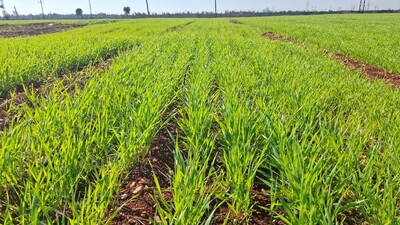
On February 16, 2026, under the African Development Bank (AfDB)’s Technologies for African Agricultural Transformation II (TAATII) Wheat Compact, ICARDA co-organized a field day at Elmangel Innovation Platform (IP) in Alhuda Subsection of the Gezira Scheme in Sudan with Mahgoub Sons, Gezira Scheme, and farmer organizations.
Sixty-nine participants attended, including farmers from the Gezira Scheme and other associations, researchers from Sudan’s Agricultural Research Center (ARC), seed production and extension staff, and representatives of private and insurance companies.
Building a Stronger Wheat Sector
Sudan’s wheat sector has been through a difficult journey. In the early 2010s, the country depended on imported seed to increase its domestic wheat production. However, the varieties were not always suited to local conditions, quality was inconsistent, and delivery delays disrupted planting cycles.
In 2016, ICARDA conducted an assessment of the wheat seed sector and supported the development of a national roadmap to boost domestic production. A key shift was the integration of the private sector into the value chain. Since then, domestic production has grown from less than 5,000 tons to more than 50,000 tons, with a surplus for export.
Despite the conflict in Sudan, the TAATII Wheat Compact is currently boosting wheat seed production by partnering with more than 10 private seed companies and key players in Sudan's agricultural sector.
A Closer Look at a New Wheat Variety
During the field visit, farmers were introduced to Ashri, a relatively new wheat variety developed by Mahgoub Sons Company. Ashri stands out for its heat tolerance, early maturity, and flexibility for sowing dates. Also, its strong spike structure reduces the risk of bird damage and retains grain well even with delayed harvest, while its firm stems minimize lodging. On top of that, it produces high yields and has grain quality preferred across the value chain. The field day also highlighted the unique potential of the Ashri variety to boost wheat productivity and serve as a reliable backup for the widely grown Imam variety, laying the foundation for the sustainable transformation of Sudan's wheat sector.
Listening, Sharing, and Planning Ahead
Following the field visit, participants came together for an open discussion on next steps. The conversation focused on strengthening farmer associations and building practical partnerships.
Mr. Yasser Nugud highlighted the need to establish and support farmer groups, while Dr. Amani Idris, Director of Technology Transfer and Knowledge Management at ARC, emphasized that organized farmer groups are key to improving access to finance, private-sector support, and new technologies. Mr. Omer Ibrahim Habani, the Director of Mahgoub Sons Company, said that “MSC has the capacity to provide integrated agricultural inputs and services”, stressing the value of well-defined and structured agreements for ensuring sustainability.
Farmer representatives pointed to the benefits of collective action in consolidating land, ensuring loan repayment, and sustaining partnerships, while calling for expanded collaboration and clarity on insurance arrangements. To address farmers’ concerns around risk, the insurance representative outlined available coverage and compensation processes.
More importantly, the event highlighted the importance of the IP approach, showing that progress depends on coordination between farmers who organize themselves, private seed companies that invest and deliver, research and development institutions that support and guide, and policymakers who create enabling environments.
About TAAT-Wheat
The Technologies for African Agricultural Transformation (TAAT) Wheat Compact, led by ICARDA, supported by the African Development Bank, promotes the adoption of improved wheat technologies across Africa. Through partnerships with national programs, TAAT is driving the continent’s journey toward wheat self-sufficiency by enhancing productivity, value addition, and market linkages, empowering farmers, women, and youth to turn grain into gain.