Protecting the First Bite of Ramadan

Across the drylands where ICARDA works, Ramadan is widely observed as a month during which Muslims fast from dawn till dusk and gather each evening for iftar, the meal that breaks the fast. From Egypt to Morocco, Oman to the United Arab Emirates (UAE), and beyond, millions begin that meal with a date, a highly nutritious fruit that holds significant religious and cultural importance.
Behind that first bite is a tree that takes years to grow and decades to sustain. Date palms are nutritional powerhouses, naturally rich in fiber, sugars, potassium, and other essential minerals, making them well-suited for restoring energy after a long day of fasting. They are also an economic backbone in dryland regions, supporting farming households, rural employment, and national markets across North Africa, the Middle East, and beyond.
Yet this system faces a growing threat, the Red Palm Weevil (RPW), which has spread across more than 50 countries, leaving 35 million trees dead or dying and affecting over 50 million farmers. In some regions, entire groves have collapsed under the RPW’s advancement. The impact extends beyond yield losses, affecting entire ecosystems, local economies, and cultural heritage.
Climate change is expected to further exacerbate the global spread of RPW. For dryland agriculture already facing water scarcity and heat stress, the pest is another pressure on an already fragile system. For farmers, this means income instability. For ecosystems, it means weakened agricultural resilience. And for communities, it threatens a crop deeply embedded in culture and faith. When a palm tree dies, something much older than it is lost.
The Consortium for Red Palm Weevil Control (C4RPWC), funded by the International Affairs Office at the UAE Presidential Court and the Gates Foundation, and implemented by ICARDA with national, regional, and CGIAR partners, is leading a shift from reaction to prevention.
Guided by decades of research, the program integrates five research-for-innovation workstreams to develop and scale sustainable solutions. These include sensors that detect larvae before visible symptoms appear, eco-friendly, cost-effective biological control agents that target the pest without harming other species, and digital monitoring platforms that use machine learning to predict outbreaks before they spread. Complemented by improved farming practices and strong community engagement, these solutions aim to restore balance, scale innovations, and protect date palms and the livelihoods of those who depend on them.
Just months after the program’s launch, early results are already visible on the ground. In Dubai’s Al Khawaneej area at one of the project’s demonstration sites, Mohamed Abdallah Khalfan, owner of a farm with more than 750 date palms, agreed to pilot the C4RPWC bundle solution.
ICARDA’s technical team has worked closely with the farm workers, providing hands-on training on key practices, including inspecting individual palms, safely removing severely infested trees, and installing and monitoring the latest RPW trapping technologies. The bundle solution brings these elements together into a coordinated system, combining improved field management, monitoring tools, and capacity building to move from reactive control to early detection and prevention.
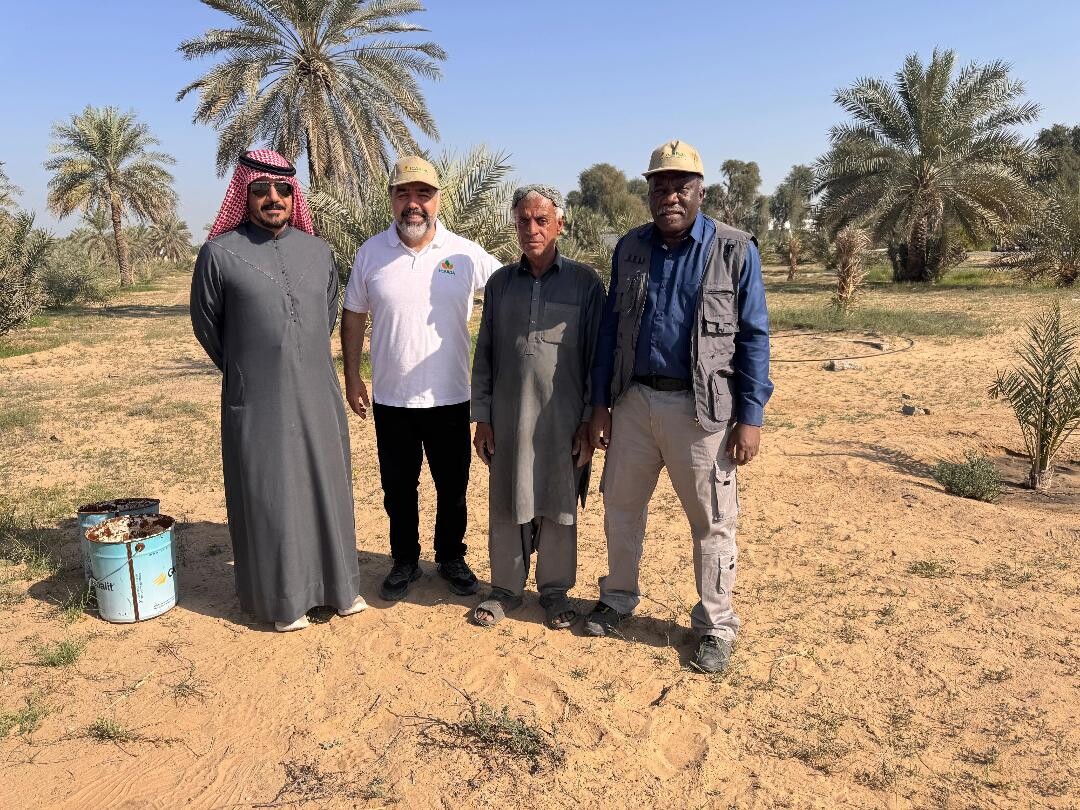
Within the first month of implementation, the initiative saw strong engagement from the UAE Ministry of Climate Change and Environment (MOCCAE) and Abu Dhabi Agriculture and Food Safety Authority (ADAFSA) agricultural and extension engineers, high willingness among farmers to participate, and readiness among farm laborers to apply the new practices on the ground.
Protecting date palms goes beyond safeguarding harvests. It helps preserve a crop woven into daily life across the region, shared in homes as a gesture of hospitality and, most notably, used to break the fast during Ramadan.