ICARDA Leads Dialogue on Water Innovation Partnerships in Egypt
ICARDA Leads Dialogue on Water Innovation Partnerships in Egypt
Date
March 17, 2026
Published by
ICARDA Communication Team
Category
News
Share
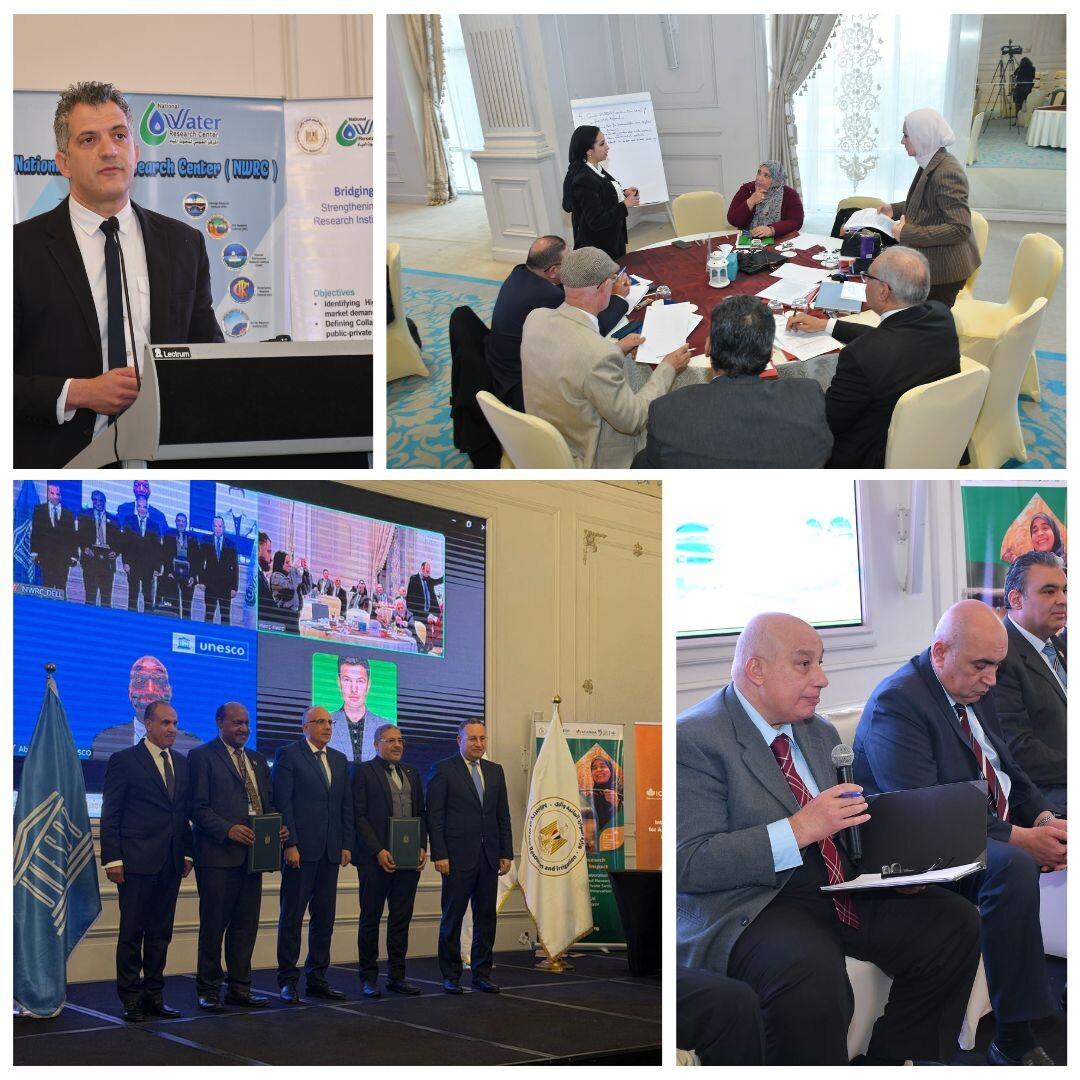
Group photo at the Bridging Research and Scalable Impact Event
Bridging research and scalable impact through strong water innovation partnerships in Egypt, scientists, policymakers, development partners, and private sector leaders gathered in Egypt’s New Capital on March 12, 2026, for a high-level workshop aimed at tackling one of the most persistent challenges in water and agricultural innovation: transforming proven research into scalable, market-ready solutions that deliver real impact for farmers and water managers.
Convened by ICARDA and the National Water Research Centre (NWRC), in collaboration with the Ministry of Water Resources and Irrigation (MWRI), UNESCO, and the European Union (EU) Delegation to Egypt, the workshop—titled “Bridging Research and Scalable Impact”—went beyond discussion to produce concrete institutional, financial, and governance pathways for accelerating innovation uptake in water-scarce environments.
A photo collage of the Bridging Research and Scalable Impact event
Why Bridging the Gap Matters
Across Egypt and the wider Middle East and North Africa, research institutions have developed a strong pipeline of proven innovations—from smart irrigation and digital water tools to treated wastewater reuse and integrated agriculture–aquaculture systems. Yet many of these solutions still struggle to move beyond pilot projects.
Dr. Sherif Mohamady while delivering opening remarks
“Too often, valuable research outcomes remain confined to reports, pilot projects, or experimental stations. The pathway from research to real world impact is frequently slow, fragmented, or uncertain.” — Dr. Sherif Mohamady, President, National Water Research Centre
The workshop builds on ICARDA’s longstanding research and partnerships in Egypt at the local and international levels, which have already shown what is possible when science is applied on the ground. Over the past decade, ICARDA has worked with national partners to improve irrigation efficiency, deploy digital decision support tools, and increase crop per drop productivity across old and newly reclaimed lands. While field research has proven the concept of technologies such as sensors, thermal imaging, and data-driven irrigation scheduling, scaling these solutions remains the key challenge the workshop set out to address.
Partnerships as the Engine of Scale
A central message emerging from the workshop was that scalability cannot be achieved by research institutions acting alone.
Dr. Mohie Omar while presenting ICARDA innovations
“Scalability goes far beyond research and far beyond a few isolated applications. True scalability requires collaboration among research institutions, government entities, the private sector, and international partners.” — Dr. Mohie Omar, ICARDA Country Director for Egypt
Discussions highlighted how misaligned timelines, regulatory uncertainty, and limited trust between academia and business continue to slow progress. Researchers are often rewarded for publications rather than impact, while private companies struggle to engage with public institutions that lack clear commercialization mechanisms.
“Researchers and businesses often operate in parallel, guided by different incentives, timelines, and expectations. Bridging these worlds requires structured partnerships built on trust, shared objectives, and supportive institutional frameworks.” — Dr. Sherif Mohamady, NWRC
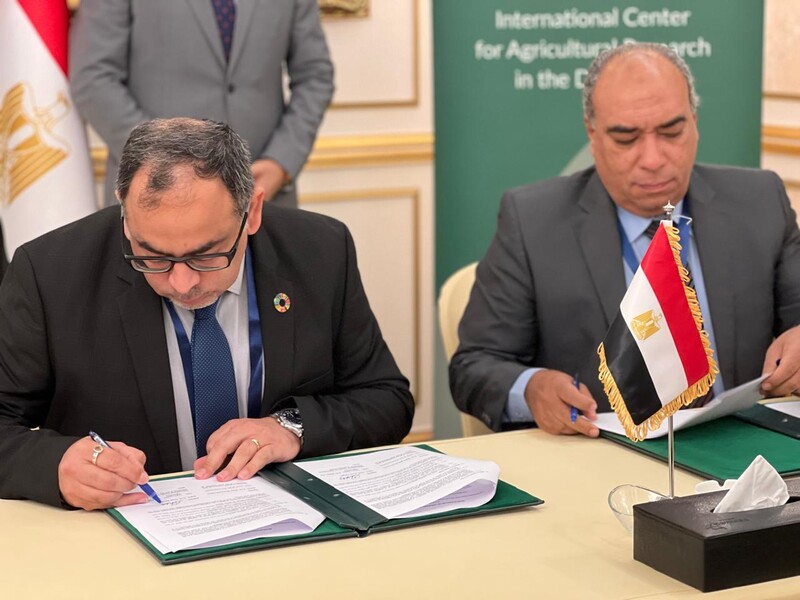
The workshop reflected a broader institutional shift in how ICARDA and its national partners approach innovation. In 2024, ICARDA and Egypt’s MWRI formalized a renewed cooperation agreement during Cairo Water Week, explicitly recognizing that research impact depends on structured pathways to implementation and investment. By convening research institutions, policymakers, and private companies around concrete pilots and governance reforms, the March 2026 workshop operationalized this commitment—translating strategy into delivery.
ICARDA and MWRI representatives while signing MoU at CWW '24
From Dialogue to Design: Concrete Solutions
ICARDA designed the workshop to move beyond diagnosis and into delivery. Drawing on its Egypt and MENA research portfolio and long-term partnerships, ICARDA steered a codesign process that produced implementable reforms and bankable pilots. ICARDA helped participants agree on a set of practical steps to accelerate impact:
Strengthening the pathway from research to market: Participants agreed to establish dedicated Technology Transfer Units within NWRC and affiliated research centers. Supported by ICARDA, these units will help turn promising research results into solutions that are ready for investment and real-world use.
Rewarding real world impact: ICARDA guided discussions on updating incentive systems so that researchers are recognized not only for publications, but also for working with industry, licensing innovations, and seeing solutions adopted in the field.
Unlocking financing for scale: To address the funding gap that often blocks innovations after pilot stages, ICARDA convened policymakers, financiers, and private companies to shape the Water Innovation Catalyst—a blended financing approach that combines public funding and private investment to help solutions grow from pilots to scale.
Creating clear rules for collaboration: Participants also agreed on standardized public–private partnership templates and an Innovation Coordination Platform to ensure transparent governance, clear intellectual property arrangements, and regular performance review.
These decisions are already moving into practice through three ICARDA backed pilot initiatives: a Smart Irrigation Demonstration Farm, a Water Reuse Enabling Framework for peri urban agriculture, and a Regional Innovation Knowledge Platform designed to support collaboration and scaling across borders.
“What determines success is not scientific discovery alone, but our ability to connect science, policy, and markets within a coherent innovation ecosystem.” — Dr. Mohie Omar, ICARDA
Priority Areas for Collaboration
Workshop participants also identified several areas where collaboration between research institutions and the private sector could have a tangible impact.
Smart irrigation and digital water management, including sensor-based systems and data-driven decision tools
Non-conventional water resources, particularly treated wastewater reuse for agriculture
Integrated agriculture–aquaculture systems that maximize water productivity while diversifying livelihoods
In the area of non-conventional water resources, the workshop proposals drew directly on ICARDA’s experience under the ReWater MENA initiative, which has helped develop safe, economically viable models for treated wastewater reuse across Egypt and the region.
Strengthening Regional and Institutional Foundations
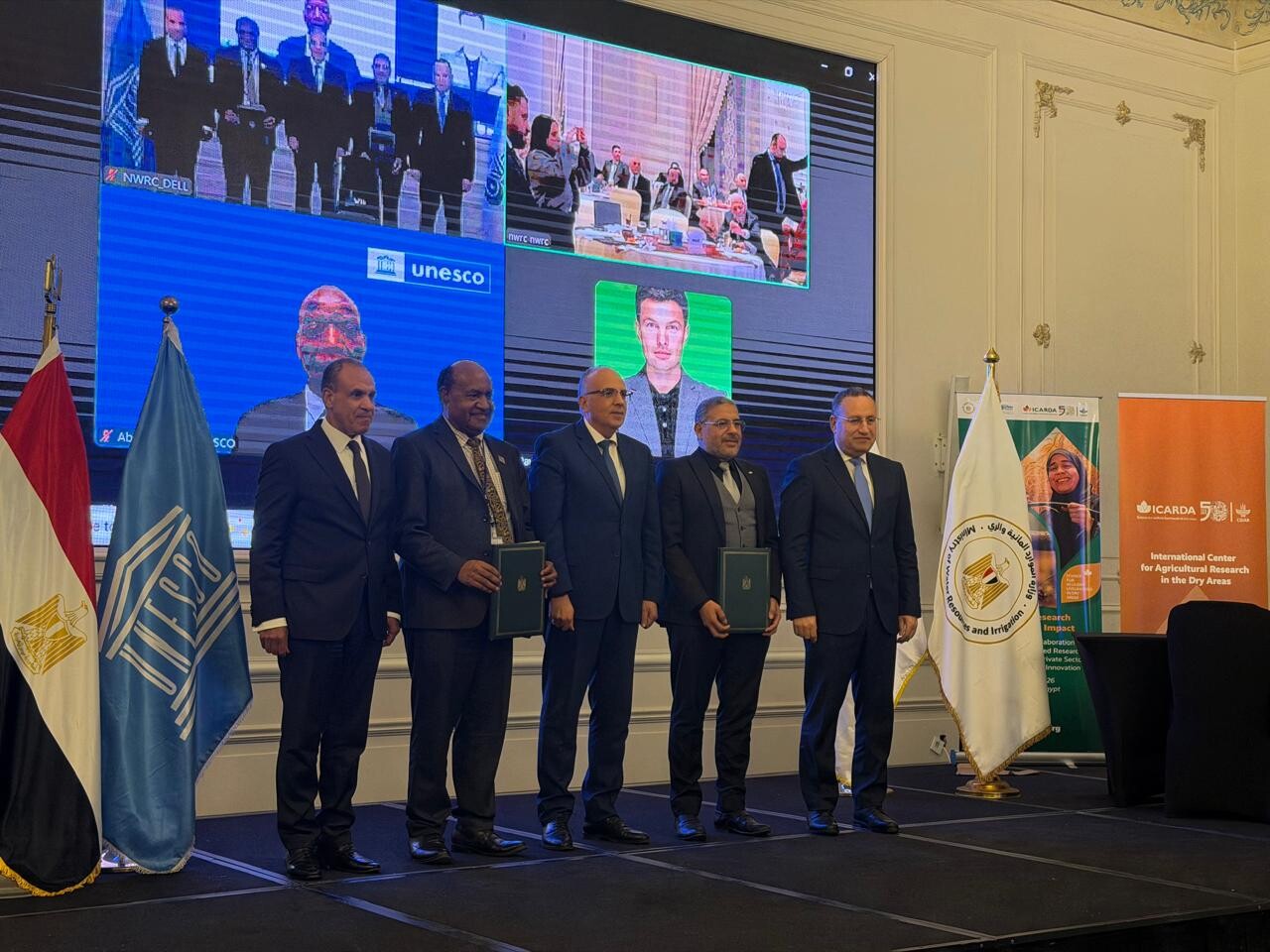
The workshop concluded with a celebratory ceremony marking the formal signing of the UNESCO Chair Agreement, which established the “UNESCO Chair on Transboundary Water Management and Governance” in partnership with NWRC.
The workshop concluded with a celebratory ceremony marking the signing of the UNESCO Chair Agreement, establishing the “UNESCO Chair on Transboundary Water Management and Governance” in partnership with NWRC. The ceremony was attended by Egypt’s Minister of Water Resources and Irrigation, H.E. Hani Sewilam; Minister of Higher Education and Scientific Research, H.E Dr. Abdel Aziz Mohamed Saad Qansouh; and Minister of Foreign Affairs, H.E. Badr Abdelatty, underscoring Egypt’s commitment to advancing transboundary water governance and international cooperation. The Chair will serve as a regional platform for applied research, policy dialogue, and capacity building on shared water challenges.
Looking Ahead
By moving decisively from problem diagnosis to solution design, the workshop marked a shift in how water innovation partnerships are conceived in Egypt and the region. Importantly, the workshop builds on ICARDA’s sustained engagement in national and regional water dialogues, including its leadership role at Cairo Water Week and the Regional Water Scarcity Initiative Programme.
Ministers of Egypt, UNESCO representative, and NWRC President at the signing ceremony
The workshop underscored that the essential elements for progress are already aligned: scientific leadership, growing institutional commitment, and a clear private sector appetite for collaboration in water and agriculture innovation. Through ICARDA’s proposed coordination mechanism and the landmark UNESCO Chair on Transboundary Water Management and Governance, the defining outcome of the workshop was a shared commitment made by ICARDA and embraced by partners—to act together, both locally and regionally, and with urgency to turn research into scalable impact.
Discover how women in Egypt are improving livelihoods and water productivity through solar drying and post-harvest innovation, reducing food loss and strengthening climate resilience.
Japan and ICARDA support solar-powered irrigation and post-harvest units in Qena, Egypt, boosting water efficiency, crop productivity, and rural livelihoods.
World Soil Day is a reminder that soil is the foundation of life, yet it faces mounting pressures from climate change, degradation, and unsustainable farming. In dryland regions, where erratic rainfall and drought threaten livelihoods, conservation agriculture (CA) offers a proven pathway to restore soil health, stabilize yields, and enhance climate resilience.